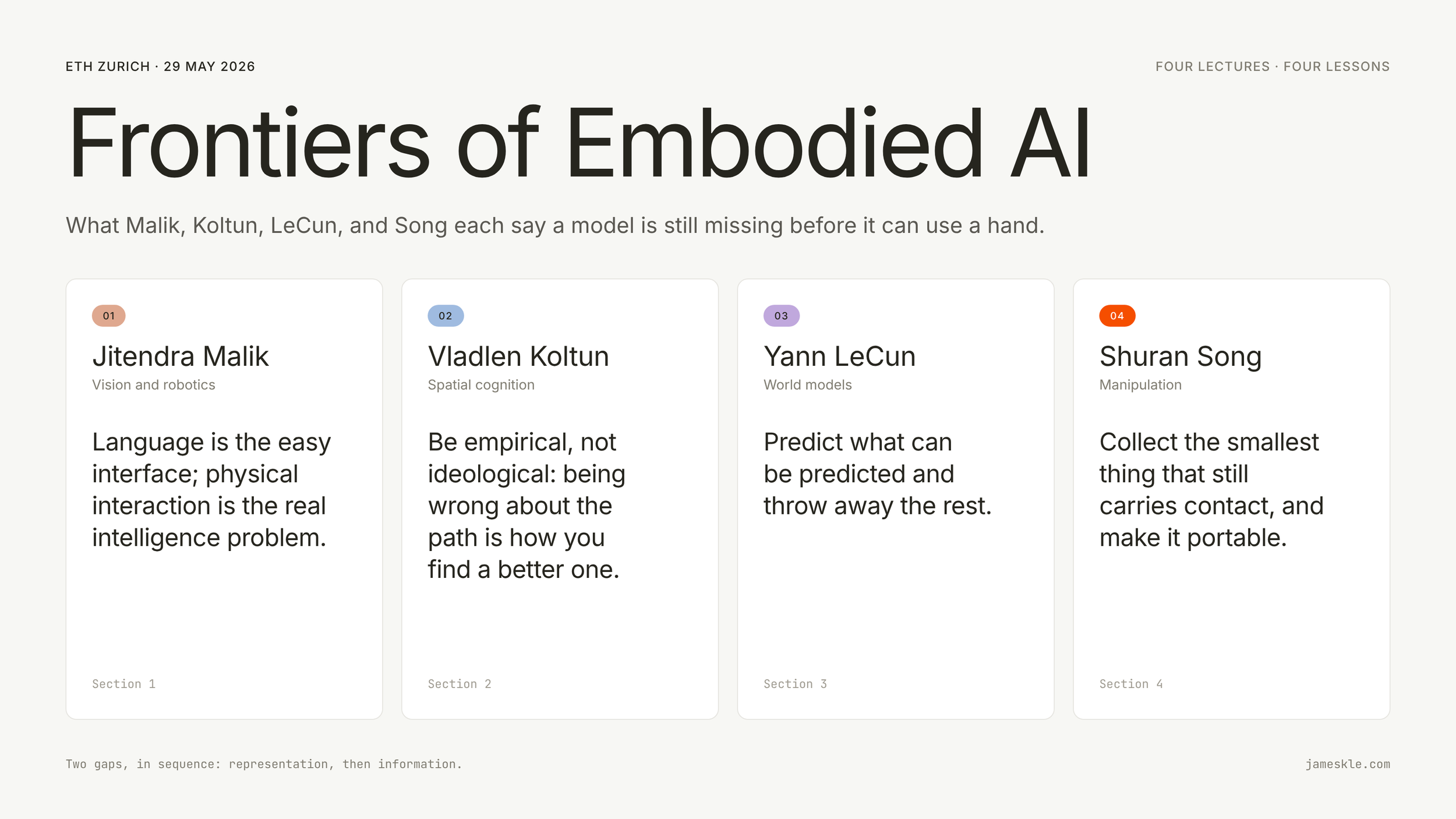
A language model can write the omelet recipe. Cracking the egg is where robots stall. That was Jitendra Malik's opening example at ETH Zurich on 29 May 2026, the first of four lectures under the title Frontiers of Embodied AI. I watched all four, about 3 hours 17 minutes in total, and they answer four different questions: what a robot's body needs (Malik), how well frontier models understand space (Vladlen Koltun), how a system learns a world model (Yann LeCun), and how to collect manipulation data that carries contact (Shuran Song). This post walks through them in order, then says which gap I think is the real one: a model that can't find the bathtub is missing structure, but a policy that can't feel the egg is missing a signal.
From The Euler Equation To PPO: A Recap of Stanford's AA 203
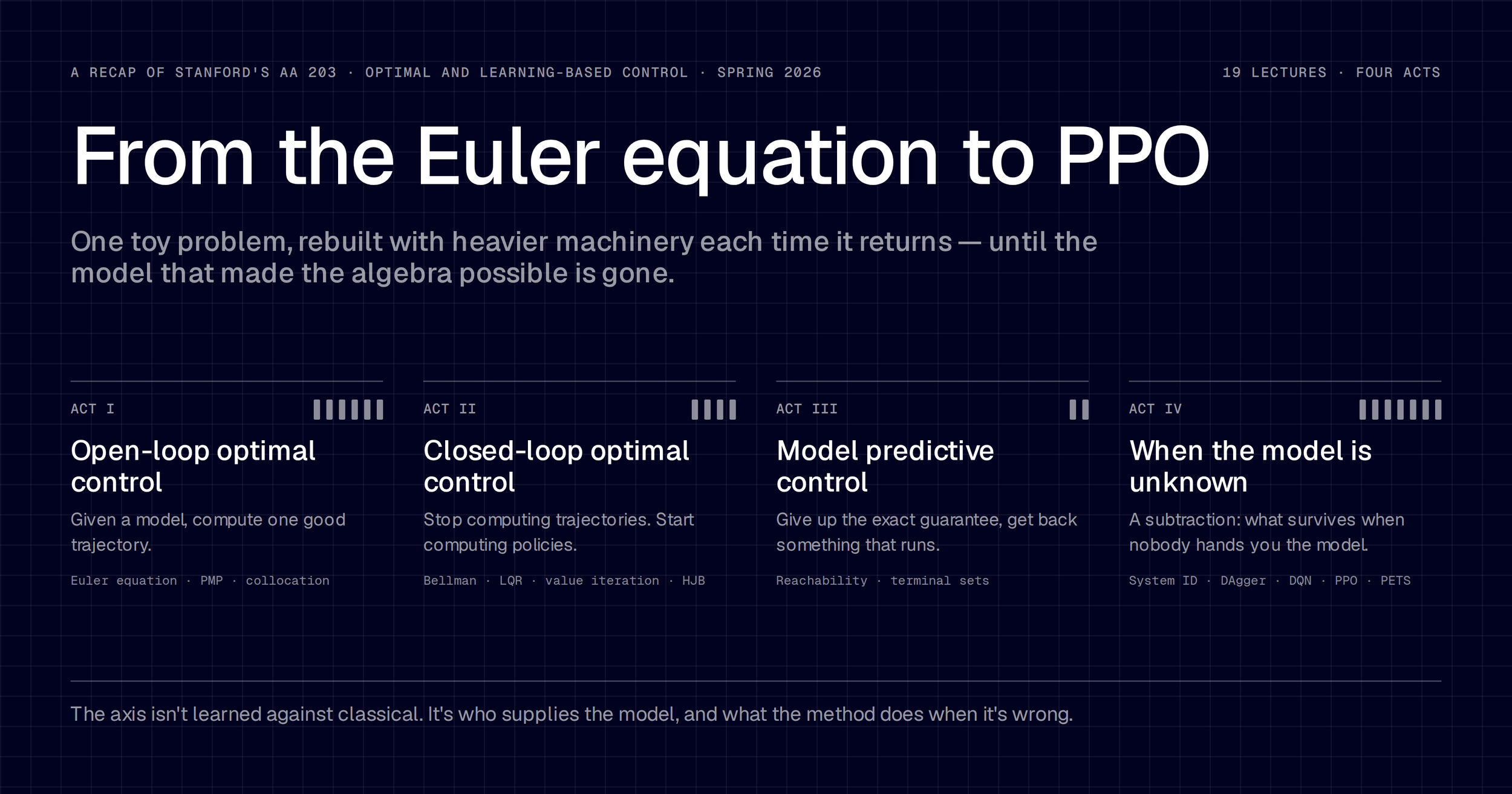
A particle sits at position 10 on a line, at rest. Lecture 4 of Stanford's AA 203 solves it by hand: write the Hamiltonian, integrate the two costates, and the optimal acceleration falls out as a straight line in time. 19 lectures later, the same question (what control do I apply right now) is answered by a neural network trained on rollouts, because the model that made the algebra possible is gone. I worked through all 19 of Marco Pavone and Daniele Gammelli's Spring 2026 lectures over three weeks in September. This recap walks the course in order, in four acts, and ends where I got stuck: what scales carries no guarantee, and what carries one stops at about six state dimensions.
Context, Compute, Capital, Culture: 13 Lectures From Stanford's CS153
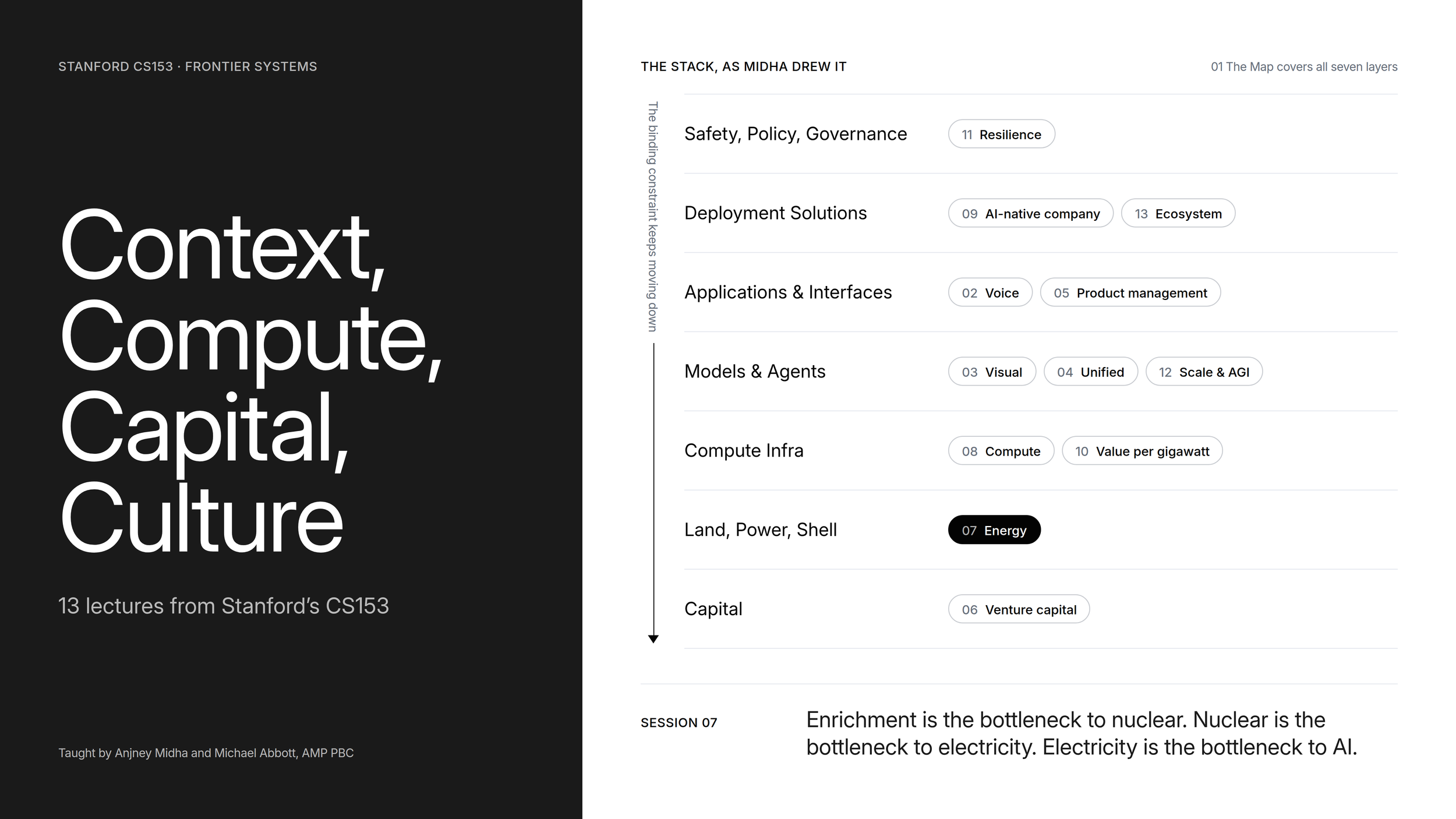
Enrichment is the bottleneck to nuclear. Nuclear is the bottleneck to electricity. Electricity is the bottleneck to AI. That slide came from the 7th of 13 sessions in Stanford's CS153: Frontier Systems. A course about frontier AI spent its midpoint on uranium. I worked through all 13 in September 2026, from Anjney Midha's opening map of the stack to guests from ElevenLabs, NVIDIA, OpenAI and Microsoft. This recap walks the course in order and reads it through the four lenses Midha gave the class: context, compute, capital and culture. It ends on the number I'll carry forward: Google depreciates its compute hardware over six years, and NVIDIA ships a new architecture every year.
13 Lectures on RLHF: What I Took Away From Nathan Lambert's Course
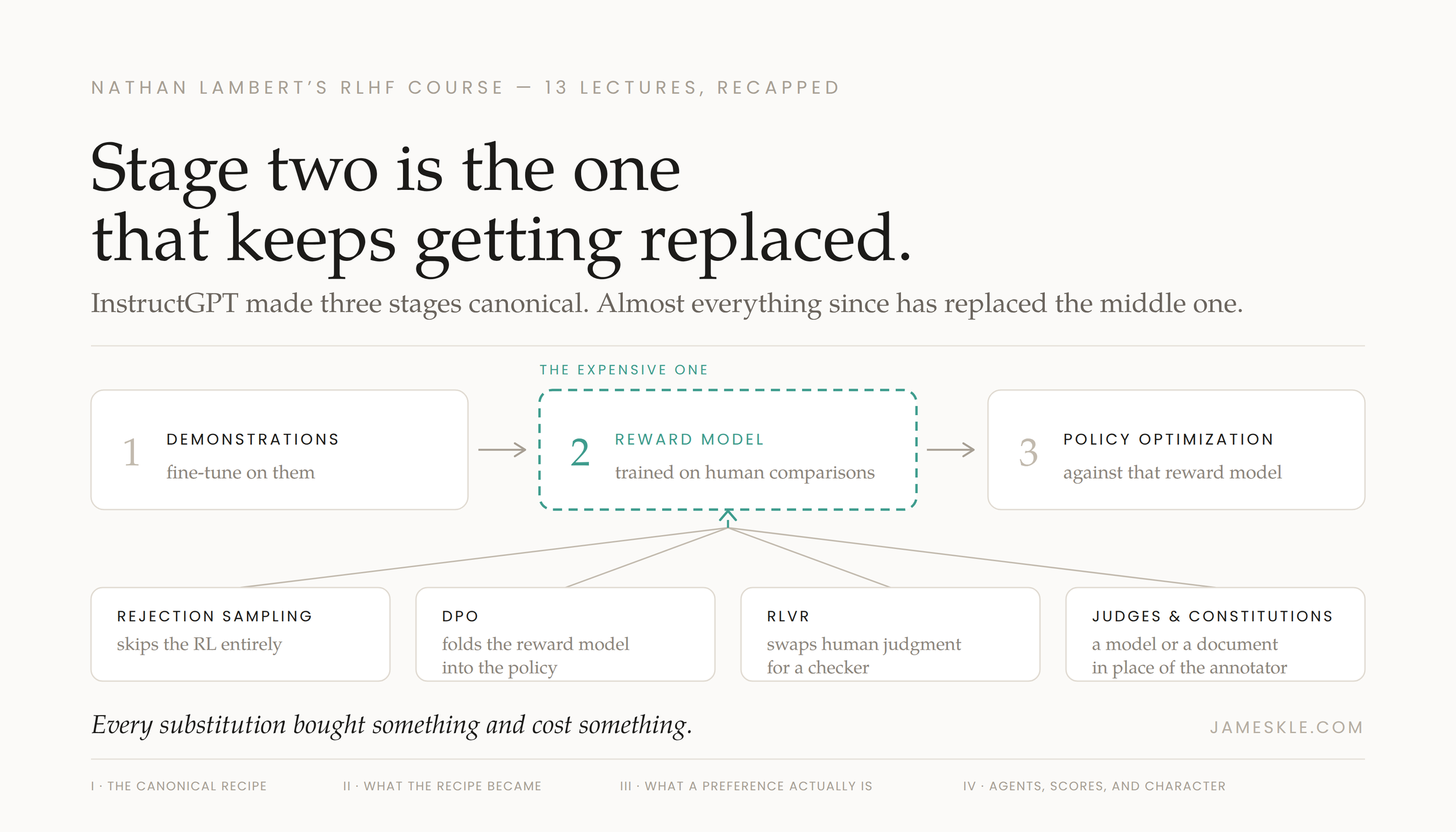
A reward model reads its score off a single token. One number. For an entire answer. Almost every complaint people have about RLHF (the hedging, the refusals nobody asked for, the model that agrees with whatever you just said) is downstream of that compression. I worked through all 13 lectures of Nathan Lambert’s course and took notes: the canonical recipe, the substitutions that keep replacing its middle stage, and the questions nobody has closed out.
9 Lectures on Self-Improving AI Agents: What I Took Away From Stanford's CS 329A
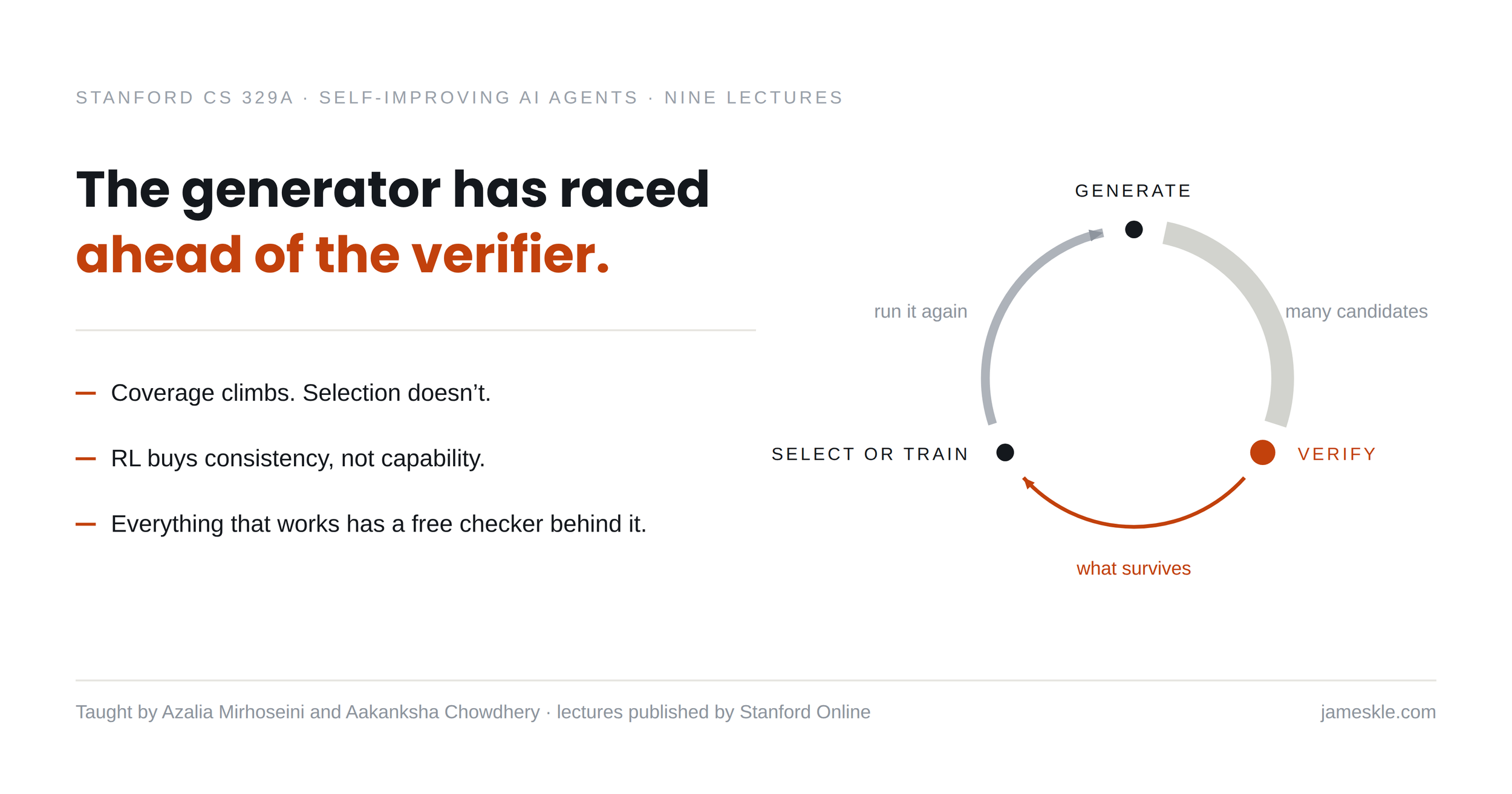
Stanford published 9 lectures from CS 329A, its graduate course on self-improving AI agents, and I spent 3 weeks last month working through them. One argument runs underneath all 9: the generator has raced ahead of the verifier. More samples put a correct answer somewhere in the pile. Nothing tells you which one it is. This recap walks the lectures in the order they were taught, and nearly every number in it came out of a PDF rather than off a slide.
What I Learned From Tecton's apply() 2022 Conference
Back in May, I attended apply(), Tecton’s second annual virtual event for data and ML teams to discuss the practical data engineering challenges faced when building ML for the real world. There were talks on best practice development patterns, tools of choice, and emerging architectures to successfully build and manage production ML applications.
This long-form article dissects content from 14 sessions and lightning talks that I found most useful from attending apply(). These talks cover 3 major areas: industry trends, production use cases, and open-source libraries. Let’s dive in!
What I Learned From Arize:Observe 2022
Last month, I had the opportunity to speak at Arize:Observe, the first conference dedicated solely to ML observability from both a business and technical perspective. More than a mere user conference, Arize:Observe features presentations and panels from industry thought leaders and ML teams across sectors. Designed to tackle both the basics and most challenging questions and use cases, the conference has sessions about performance monitoring and troubleshooting, data quality and drift monitoring and troubleshooting, ML observability in the world of unstructured data, explainability, business impact analysis, operationalizing ethical AI, and more.
In this blog recap, I will dissect content from the summit’s most insightful technical talks, covering a wide range of topics from scaling real-time ML and best practices of effective ML teams to challenges in monitoring production ML pipelines and redesigning ML platform.
Datacast Episode 61: Meta Reinforcement Learning with Louis Kirsch
Louis Kirsch is a third-year Ph.D. student at the Swiss AI Lab IDSIA, advised by Prof. Jürgen Schmidhuber. He received his B.Sc. in IT-Systems-Engineering from Hasso-Plattner-Institute (1st rank) and his Master of Research in Computational Statistics and Machine Learning from University College London (1st rank). His research focuses on meta-learning algorithms for reinforcement learning, specifically meta-learning algorithms that are general-purpose, introduced by his work on MetaGenRL. Louis has organized the BeTR-RL workshop at ICLR 2020, was an invited speaker at Meta Learn NeurIPS 2020, and won several GPU compute awards for the Swiss national supercomputer Piz Daint.
Datacast Episode 58: Deep Learning Meets Distributed Systems with Jim Dowling
Jim Dowling is the CEO of Logical Clocks AB, an Associate Professor at KTH Royal Institute of Technology, and a Senior Researcher at SICS RISE in Stockholm. His research concentrates on building systems support for machine learning at scale. He is the lead architect of Hops Hadoop, the world's fastest and most scalable Hadoop distribution and only Hadoop platform with support for GPUs as a resource. He is also a regular speaker at Big Data and AI industry conferences.
What I Learned From Attending RE•WORK Deep Learning 2.0 Summit 2021
At the end of January, I attended REWORK’s Deep Learning 2.0 Virtual Summit, which brings together the latest technological advancements and practical examples to apply deep learning to solve challenges in business and society. In this long-form blog recap, I will dissect content from the talks that I found most useful from attending the summit. The post consists of 17 talks that are divided into 5 sections: Enterprise AI, Ethics and Social Responsibility, Deep Learning Landscape, Generative Models, and Reinforcement Learning.