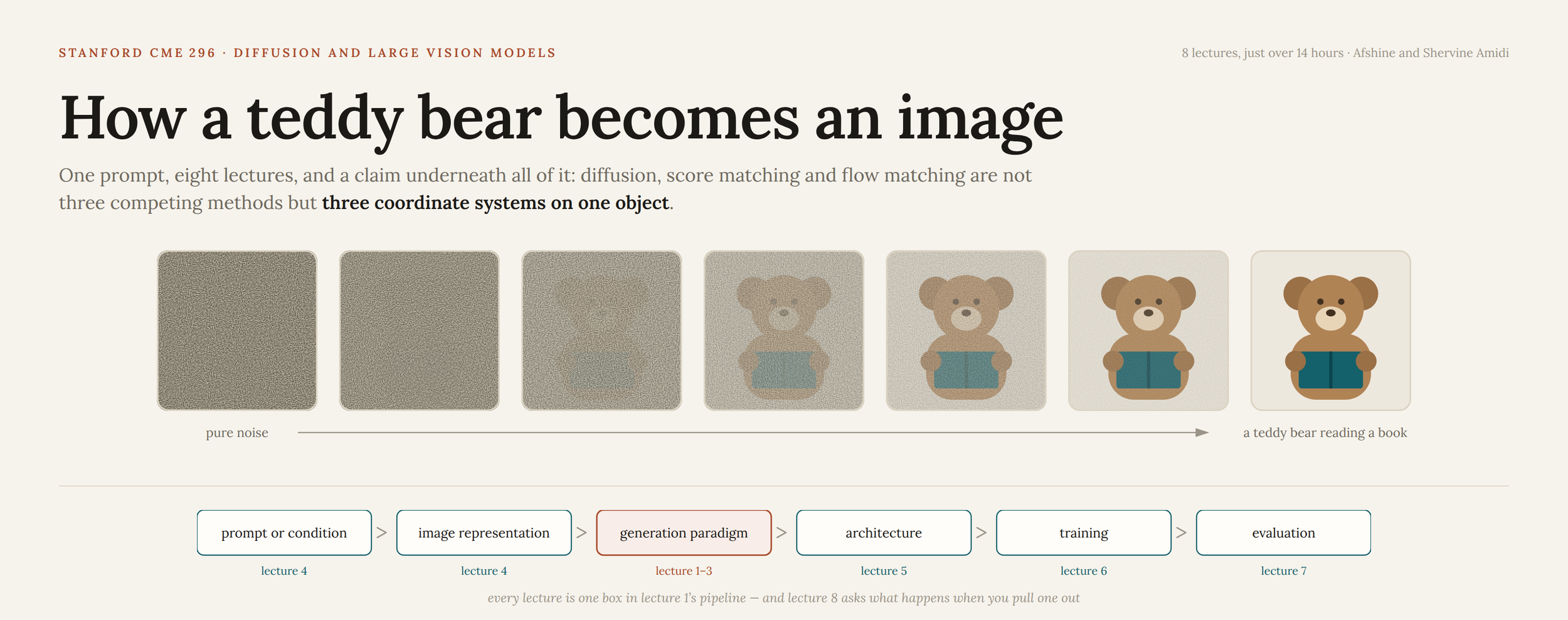
Every lecture in Stanford's CME 296 generates the same picture: a teddy bear reading a book. Noise on the first slide, a finished image on the last. I watched all 8 lectures from Afshine and Shervine Amidi, just over 14 hours of video. The claim underneath them: diffusion, score matching, and flow matching are three coordinate systems on one object. This recap walks the course in order and argues that FID is a regression test the field keeps publishing as a result. One problem won't yield to a better loss, provenance you can strip with a screenshot.
Datacast Episode 64: Improving Access to High-Quality Data with Fabiana Clemente
Fabiana Clemente is a Data Scientist with a background that ranges from Business Intelligence to Big Data Development and IoT architecture. Throughout her professional career, she has been leading state-of-the-art projects in global companies and startups. She has an academic background in Applied Maths, and MSc in Data Management combined with nano degrees in Deep Learning and Secure and Private AI.
As YData’s Co-Founder, she combines Data Privacy with Deep Learning as her main field of work and research, with the mission to unlock data with privacy by design. She also aims to inspire more women to follow her steps and join the tech community.
What I Learned From Attending RE•WORK Deep Learning 2.0 Summit 2021
At the end of January, I attended REWORK’s Deep Learning 2.0 Virtual Summit, which brings together the latest technological advancements and practical examples to apply deep learning to solve challenges in business and society. In this long-form blog recap, I will dissect content from the talks that I found most useful from attending the summit. The post consists of 17 talks that are divided into 5 sections: Enterprise AI, Ethics and Social Responsibility, Deep Learning Landscape, Generative Models, and Reinforcement Learning.


