Body, Space, World, Data: Four Lectures on Embodied AI From ETH Zurich

Body, Space, World, Data: Four Lectures on Embodied AI From ETH Zurich

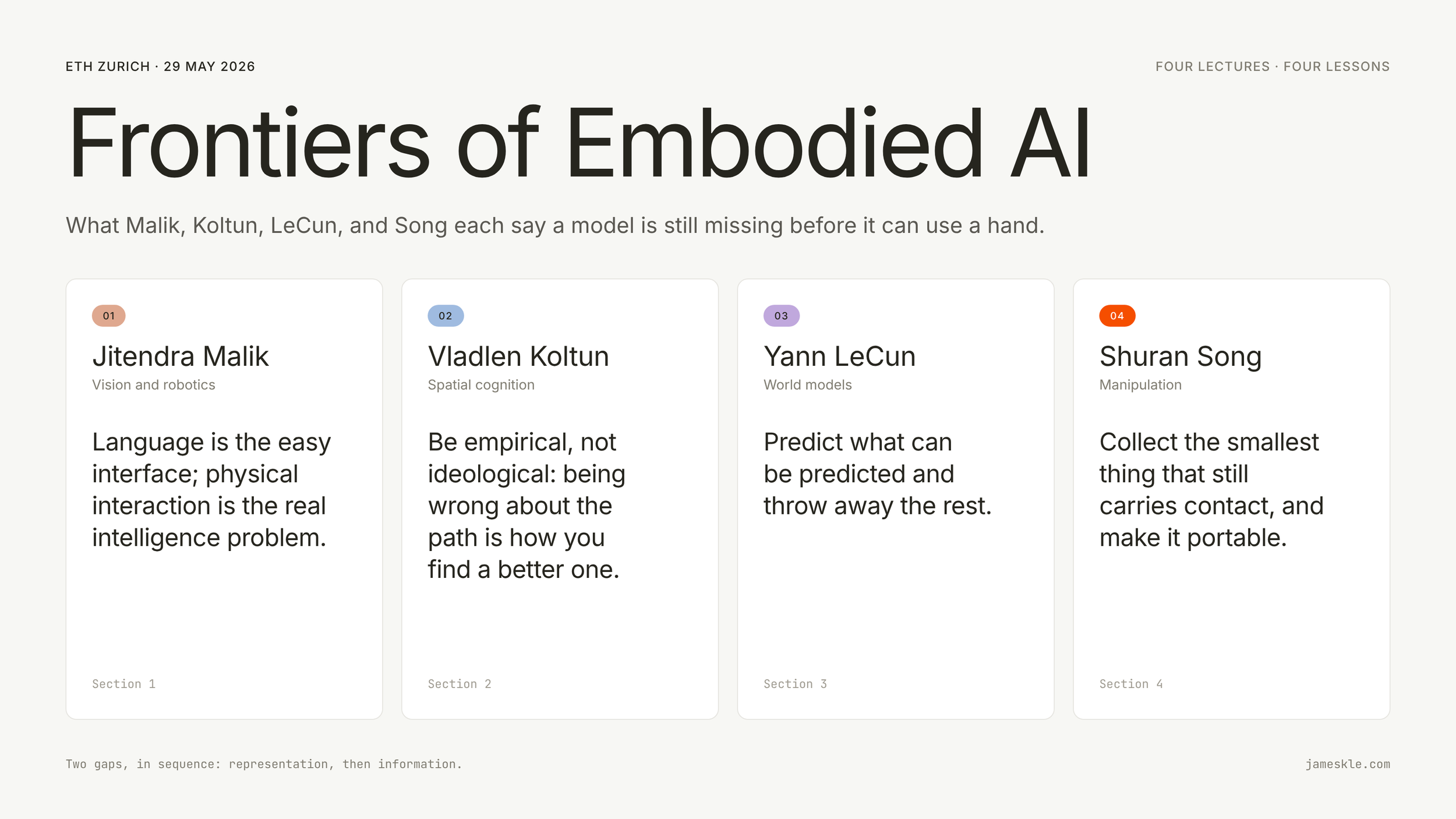
A language model can write the omelet recipe. Cracking the egg is where robots stall. That was Jitendra Malik's opening example at ETH Zurich on 29 May 2026, the first of four lectures under the title Frontiers of Embodied AI. I watched all four, about 3 hours 17 minutes in total, and they answer four different questions: what a robot's body needs (Malik), how well frontier models understand space (Vladlen Koltun), how a system learns a world model (Yann LeCun), and how to collect manipulation data that carries contact (Shuran Song). This post walks through them in order, then says which gap I think is the real one: a model that can't find the bathtub is missing structure, but a policy that can't feel the egg is missing a signal.
From The Euler Equation To PPO: A Recap of Stanford's AA 203

From The Euler Equation To PPO: A Recap of Stanford's AA 203

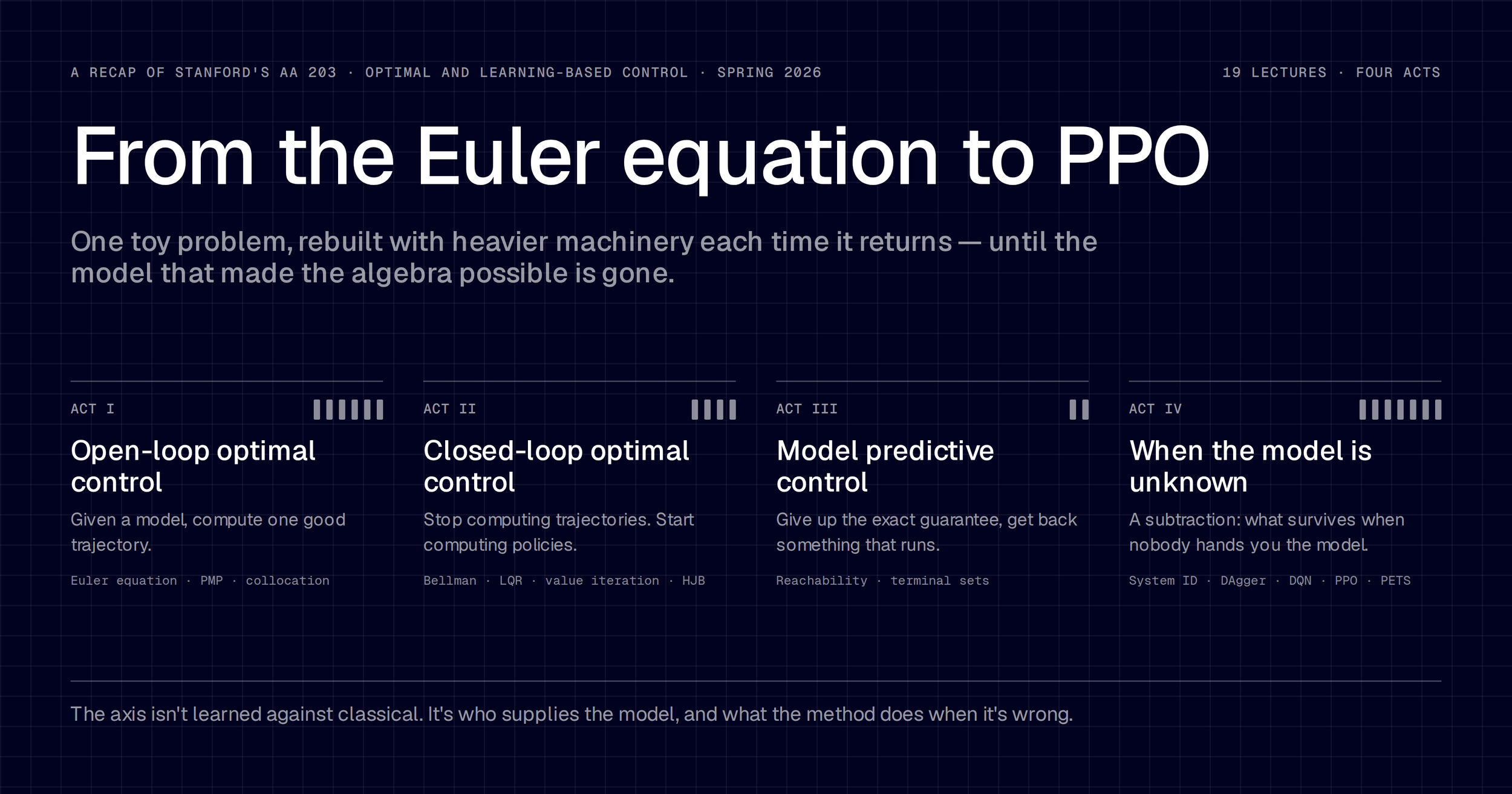
A particle sits at position 10 on a line, at rest. Lecture 4 of Stanford's AA 203 solves it by hand: write the Hamiltonian, integrate the two costates, and the optimal acceleration falls out as a straight line in time. 19 lectures later, the same question (what control do I apply right now) is answered by a neural network trained on rollouts, because the model that made the algebra possible is gone. I worked through all 19 of Marco Pavone and Daniele Gammelli's Spring 2026 lectures over three weeks in September. This recap walks the course in order, in four acts, and ends where I got stuck: what scales carries no guarantee, and what carries one stops at about six state dimensions.

Context, Compute, Capital, Culture: 13 Lectures From Stanford's CS153

Context, Compute, Capital, Culture: 13 Lectures From Stanford's CS153

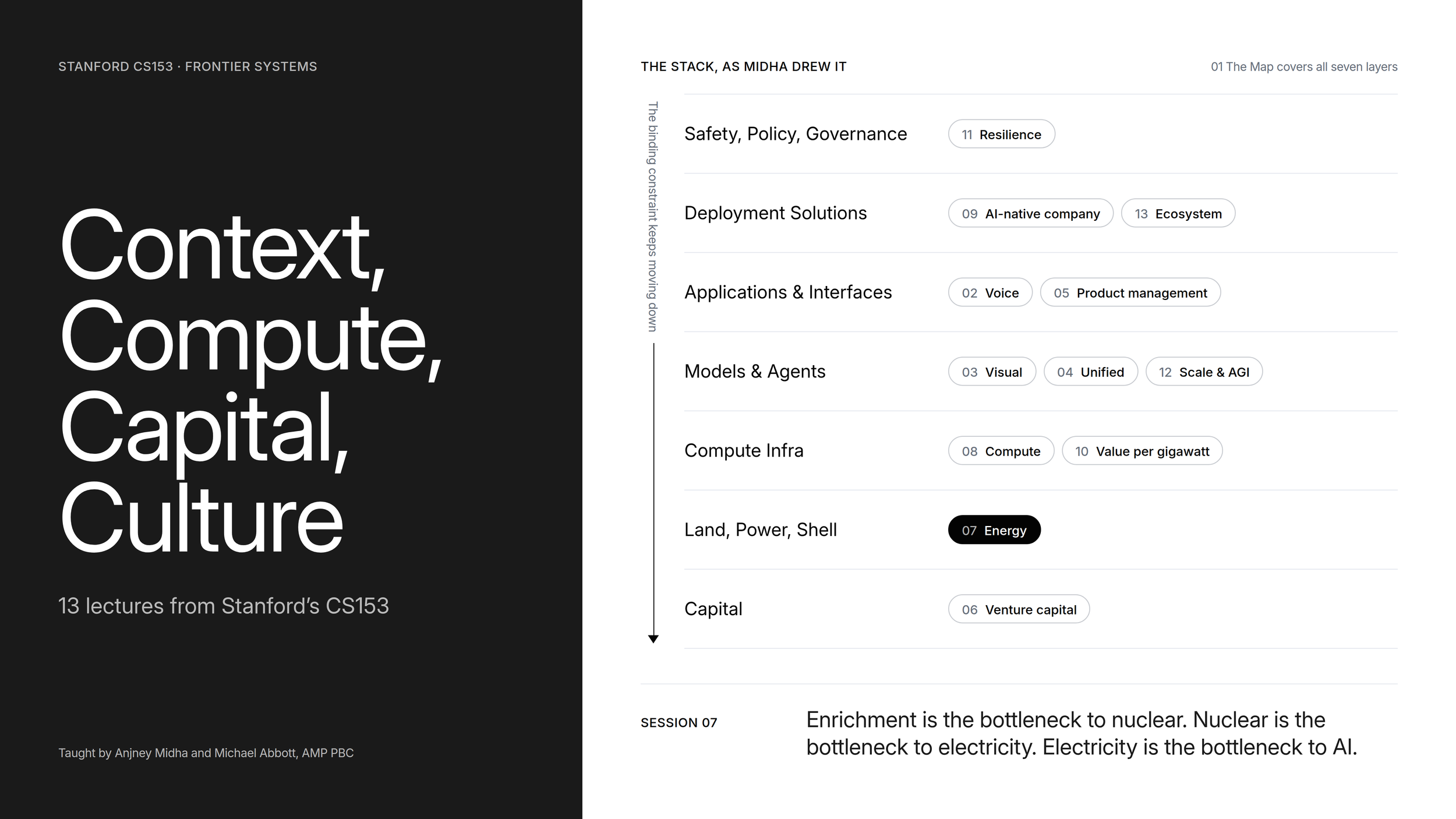
Enrichment is the bottleneck to nuclear. Nuclear is the bottleneck to electricity. Electricity is the bottleneck to AI. That slide came from the 7th of 13 sessions in Stanford's CS153: Frontier Systems. A course about frontier AI spent its midpoint on uranium. I worked through all 13 in September 2026, from Anjney Midha's opening map of the stack to guests from ElevenLabs, NVIDIA, OpenAI and Microsoft. This recap walks the course in order and reads it through the four lenses Midha gave the class: context, compute, capital and culture. It ends on the number I'll carry forward: Google depreciates its compute hardware over six years, and NVIDIA ships a new architecture every year.

Where Does The Money Actually Go? A Recap of Stanford's MS&E 435

Where Does The Money Actually Go? A Recap of Stanford's MS&E 435

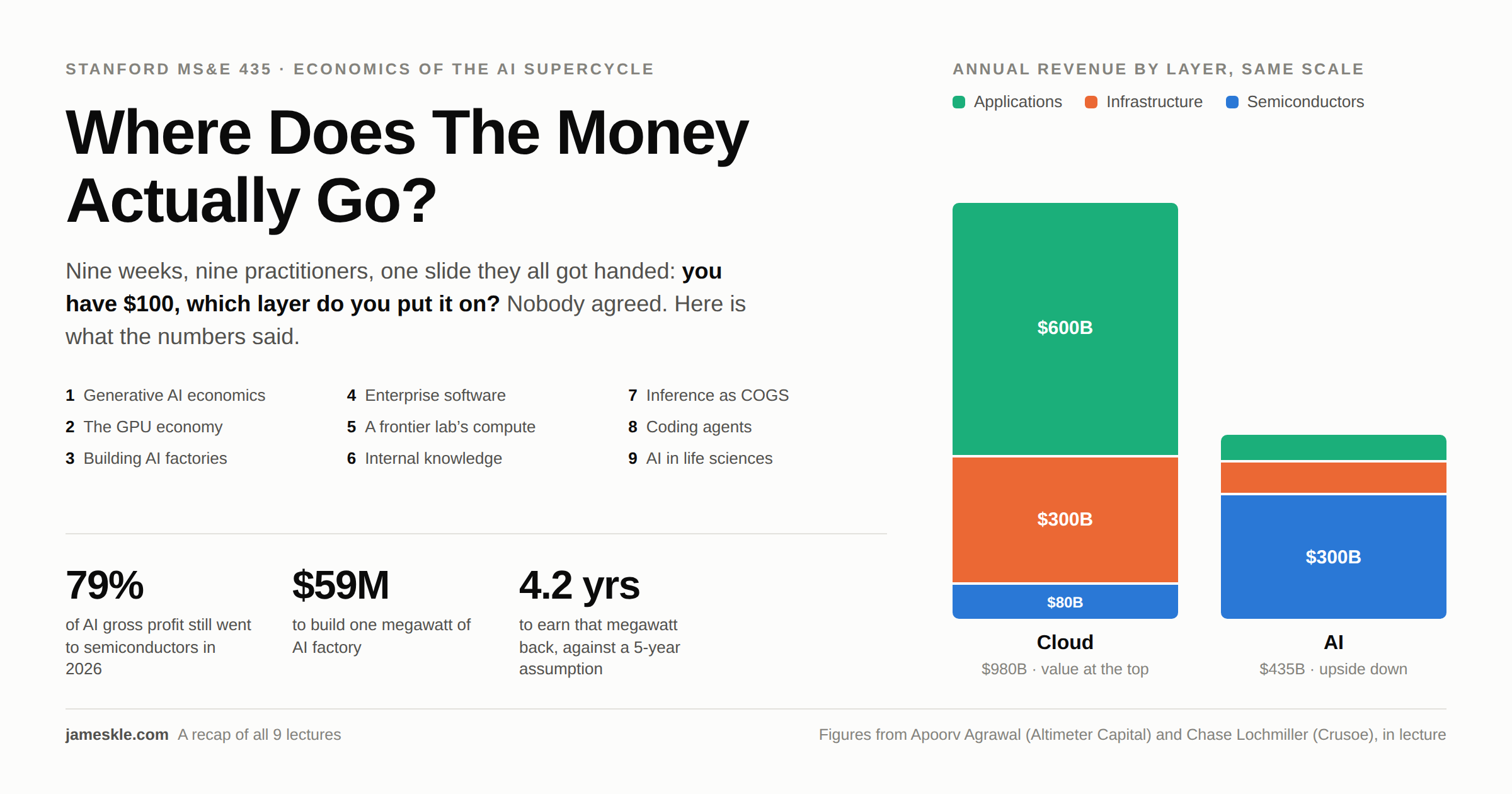
Jensen Huang's five-layer cake goes up twice in Stanford's MS&E 435, and both times the guest gets the same question: you have $100, which layer do you put it on? I worked through all 9 in August 2026. The shape underneath them: semiconductors took 79% of AI gross profit in 2026 and applications took 7%, the inverse of cloud software. This recap walks the course in order, from $59M per megawatt to a 16% antibody hit rate, and argues that "compute is scarce" has become the industry's substitute for a depreciation estimate. Nine lectures, and the number that decides whether any of it pays never appears on a slide.

Stanford CME 296, Condensed: How A Teddy Bear Becomes An Image

Stanford CME 296, Condensed: How A Teddy Bear Becomes An Image

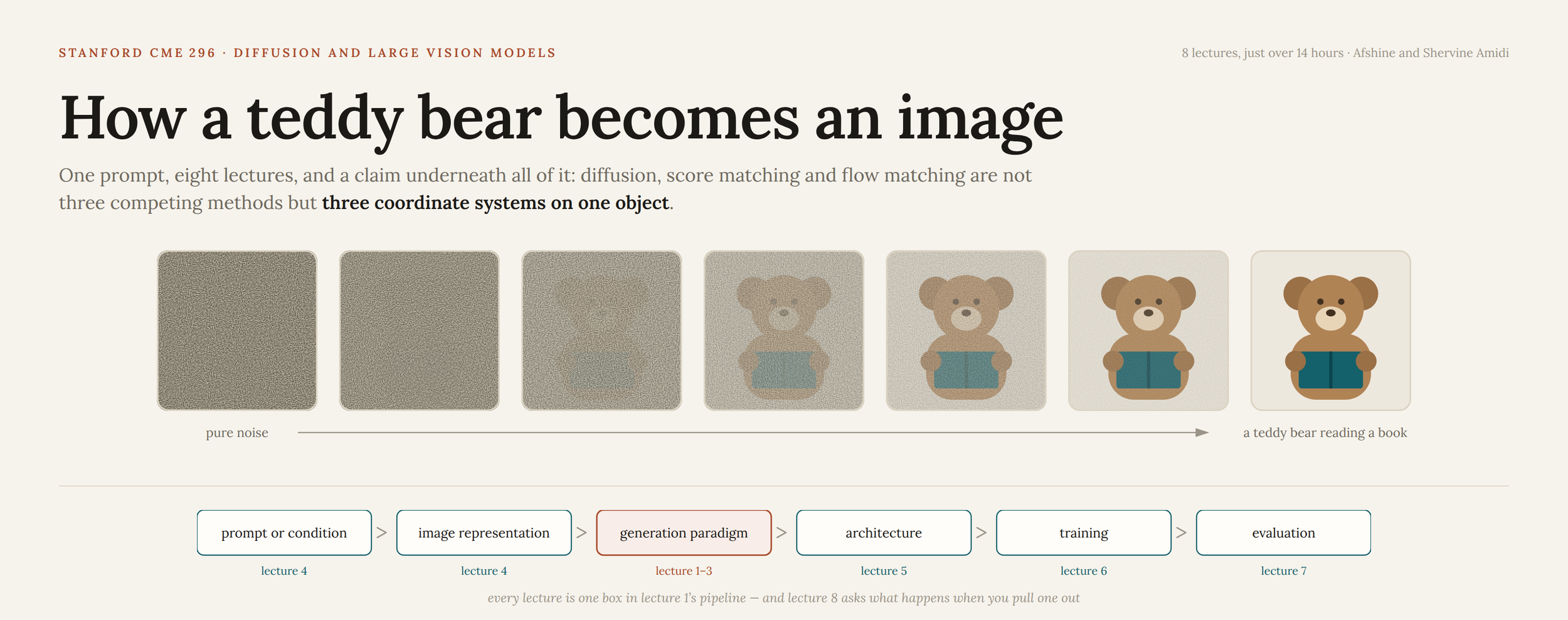
Every lecture in Stanford's CME 296 generates the same picture: a teddy bear reading a book. Noise on the first slide, a finished image on the last. I watched all 8 lectures from Afshine and Shervine Amidi, just over 14 hours of video. The claim underneath them: diffusion, score matching, and flow matching are three coordinate systems on one object. This recap walks the course in order and argues that FID is a regression test the field keeps publishing as a result. One problem won't yield to a better loss, provenance you can strip with a screenshot.

13 Lectures on RLHF: What I Took Away From Nathan Lambert's Course

13 Lectures on RLHF: What I Took Away From Nathan Lambert's Course

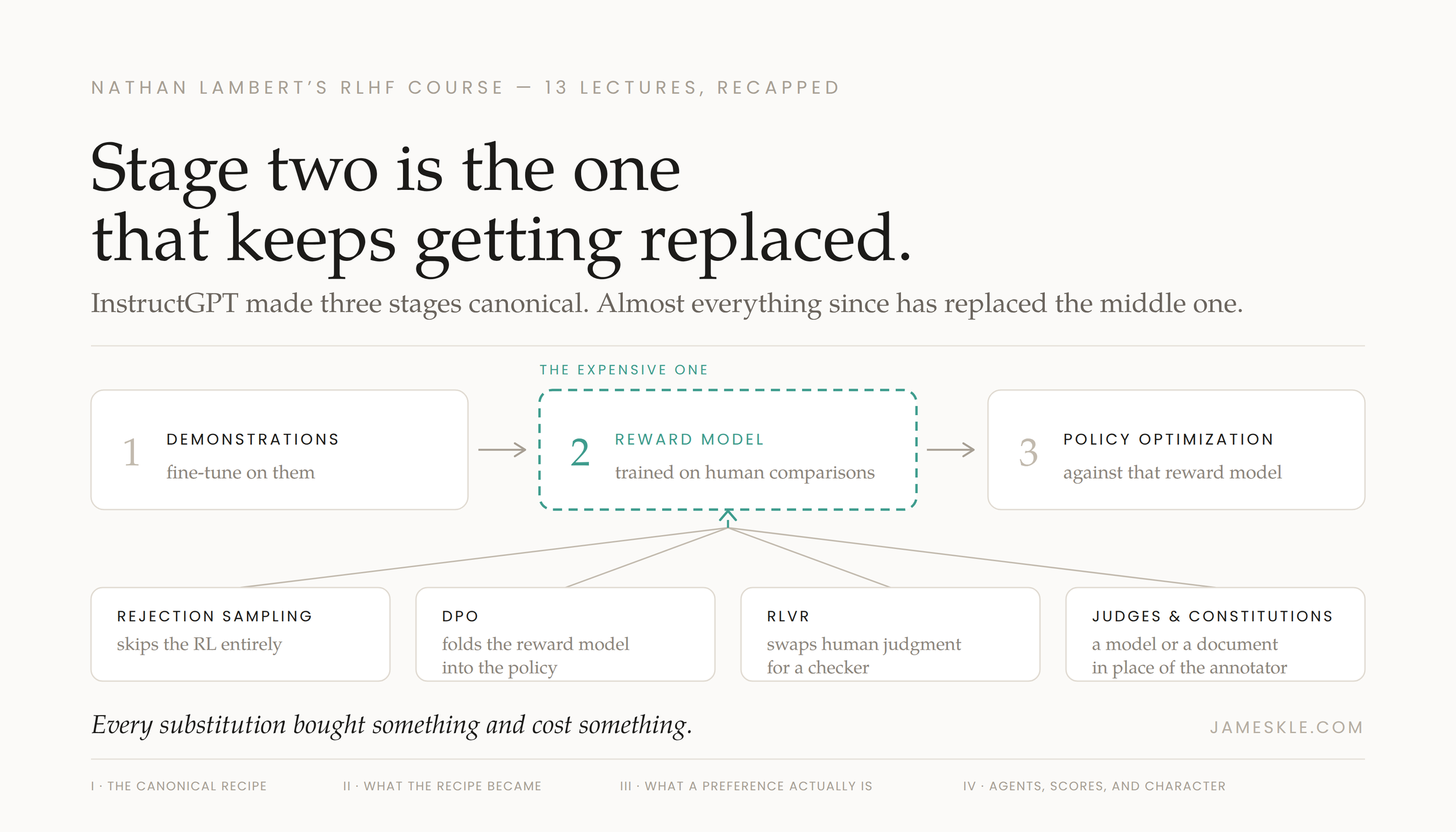
A reward model reads its score off a single token. One number. For an entire answer. Almost every complaint people have about RLHF (the hedging, the refusals nobody asked for, the model that agrees with whatever you just said) is downstream of that compression. I worked through all 13 lectures of Nathan Lambert’s course and took notes: the canonical recipe, the substitutions that keep replacing its middle stage, and the questions nobody has closed out.

9 Lectures on Self-Improving AI Agents: What I Took Away From Stanford's CS 329A

9 Lectures on Self-Improving AI Agents: What I Took Away From Stanford's CS 329A

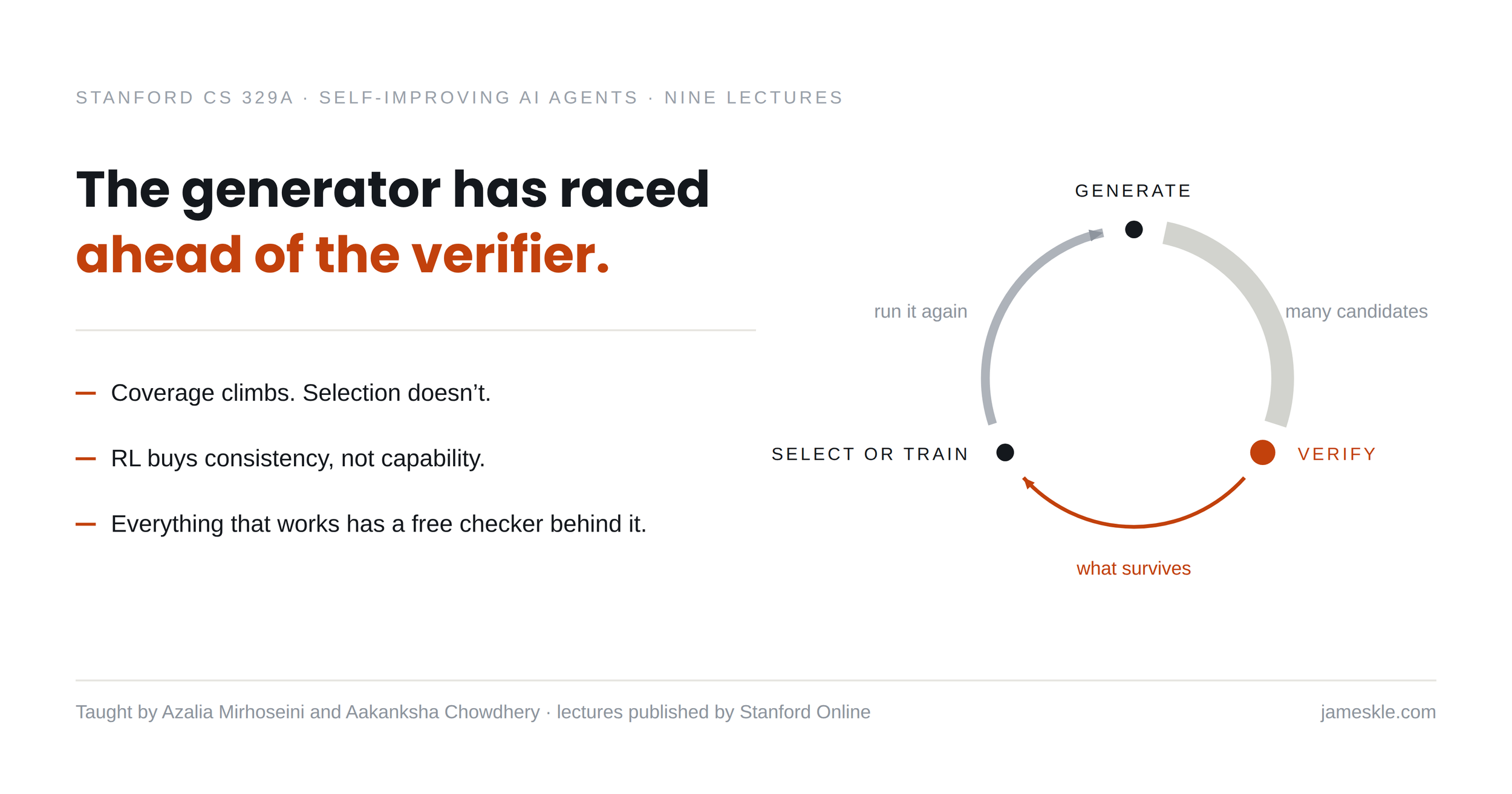
Stanford published 9 lectures from CS 329A, its graduate course on self-improving AI agents, and I spent 3 weeks last month working through them. One argument runs underneath all 9: the generator has raced ahead of the verifier. More samples put a correct answer somewhere in the pile. Nothing tells you which one it is. This recap walks the lectures in the order they were taught, and nearly every number in it came out of a PDF rather than off a slide.

2025 Annual Review - The Year of Integration

2025 Annual Review - The Year of Integration

In a world that prizes velocity and constant achievement, the act of slowing down to reflect can feel almost subversive. Yet, I’ve come to believe that this pause is not a luxury, but a necessity. The annual review is my opportunity to step off the treadmill of busyness and ask: What truly mattered this year? Where did I find meaning, fulfillment, and connection? What patterns—both constructive and limiting—emerged in my work, relationships, and inner life? By making space for these questions, I’m able to move beyond the noise of daily life and reconnect with my core values and aspirations.

As I embark on this year’s review, I do so with a sense of gratitude for the opportunities, challenges, and relationships that have shaped 2025. Growth is rarely linear, and the most profound lessons often emerge from moments of struggle, uncertainty, or unexpected change. My hope is that this reflection will not only serve as a record of what was, but as a springboard for what could be—a foundation for more intentional, impactful living in the year ahead.

2024 Annual Review - The Year of Adventure

2024 Annual Review - The Year of Adventure

As I turned 30 and reflected on 2024, this year stands as a pivotal chapter in my life's journey. Looking back at my weekly diary entries, three major themes emerged that shaped my experiences: adaptation, growth, and connection.

This milestone year brought numerous opportunities for personal and professional development. From strengthening relationships and expanding my horizons to embracing new challenges, each experience contributed to my growth journey.

Datacast Episode 133: Full Data Stack Observability with Salma Bakouk

Datacast Episode 133: Full Data Stack Observability with Salma Bakouk

Salma Bakouk is the CEO and co-founder of Sifflet, a Full Data Stack Observability platform. Before Sifflet, Salma was an Executive Director at Goldman Sachs in Sales & Trading in Asia, leading key Data & Analytics initiatives. Salma holds an Engineering Degree from École Centrale Paris in Applied Mathematics and a Master's in Statistics and Data Science.