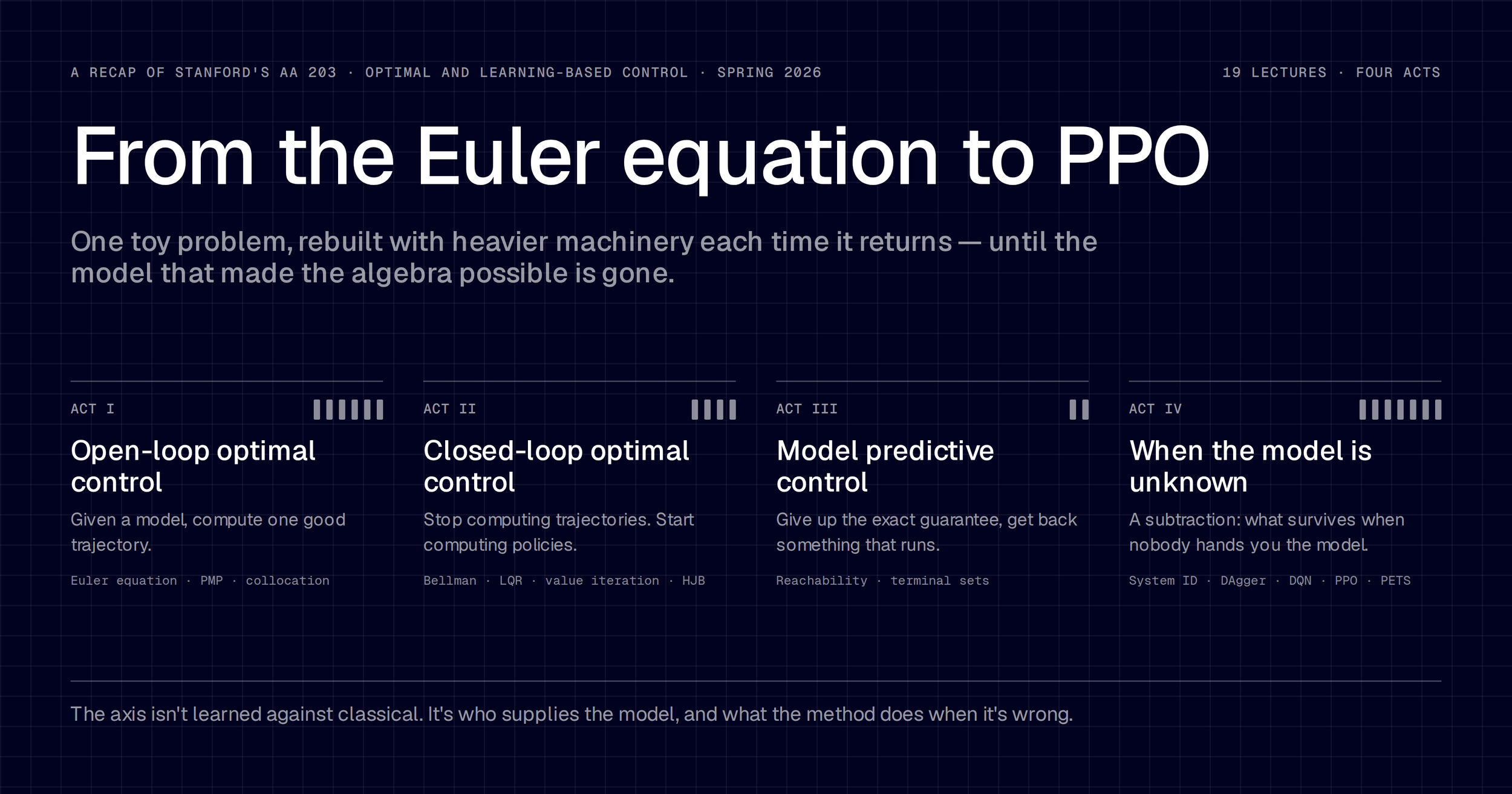
A particle sits at position 10 on a line, at rest. Lecture 4 of Stanford's AA 203 solves it by hand: write the Hamiltonian, integrate the two costates, and the optimal acceleration falls out as a straight line in time. 19 lectures later, the same question (what control do I apply right now) is answered by a neural network trained on rollouts, because the model that made the algebra possible is gone. I worked through all 19 of Marco Pavone and Daniele Gammelli's Spring 2026 lectures over three weeks in September. This recap walks the course in order, in four acts, and ends where I got stuck: what scales carries no guarantee, and what carries one stops at about six state dimensions.
Context, Compute, Capital, Culture: 13 Lectures From Stanford's CS153
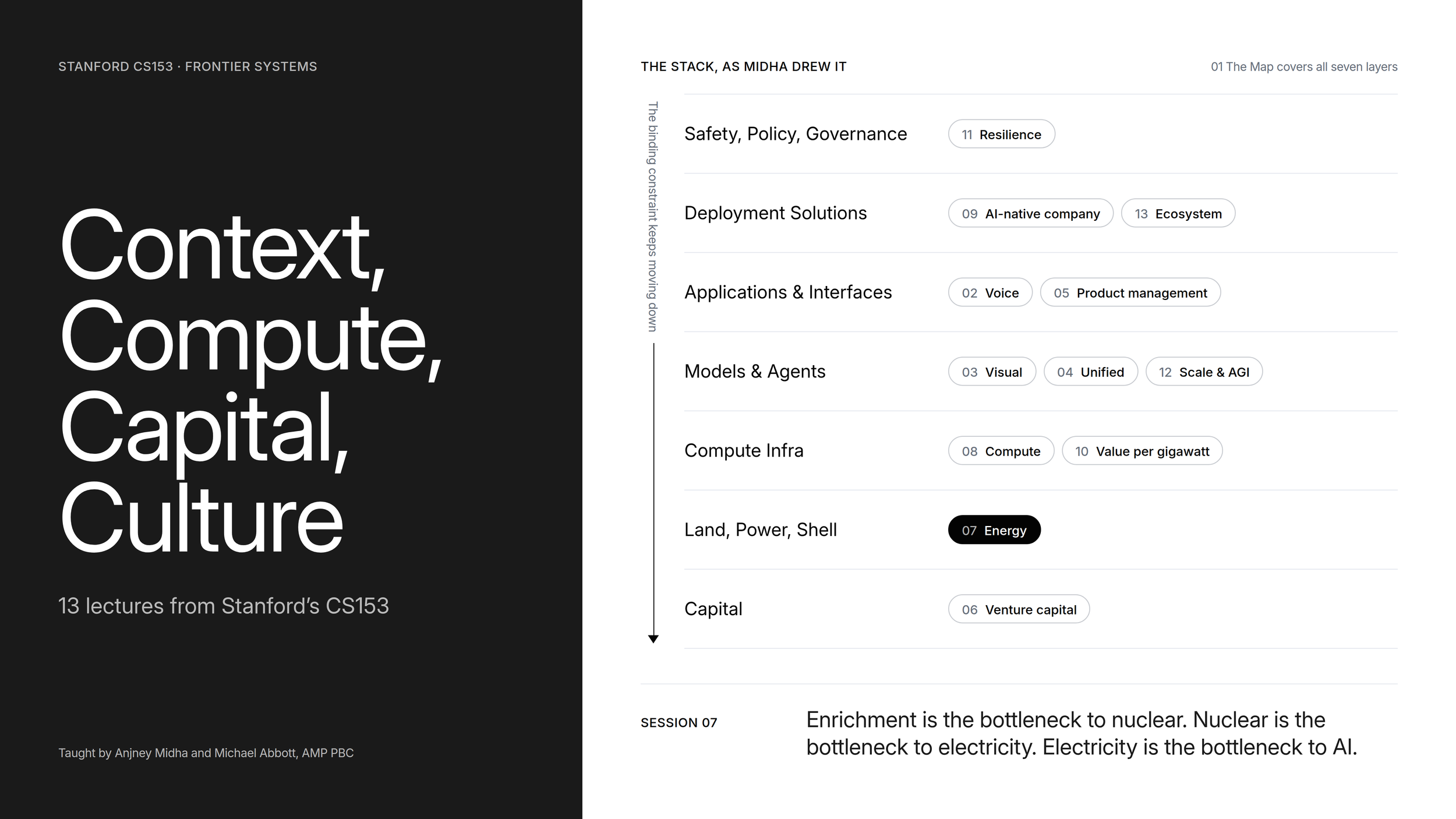
Enrichment is the bottleneck to nuclear. Nuclear is the bottleneck to electricity. Electricity is the bottleneck to AI. That slide came from the 7th of 13 sessions in Stanford's CS153: Frontier Systems. A course about frontier AI spent its midpoint on uranium. I worked through all 13 in September 2026, from Anjney Midha's opening map of the stack to guests from ElevenLabs, NVIDIA, OpenAI and Microsoft. This recap walks the course in order and reads it through the four lenses Midha gave the class: context, compute, capital and culture. It ends on the number I'll carry forward: Google depreciates its compute hardware over six years, and NVIDIA ships a new architecture every year.
Where Does The Money Actually Go? A Recap of Stanford's MS&E 435
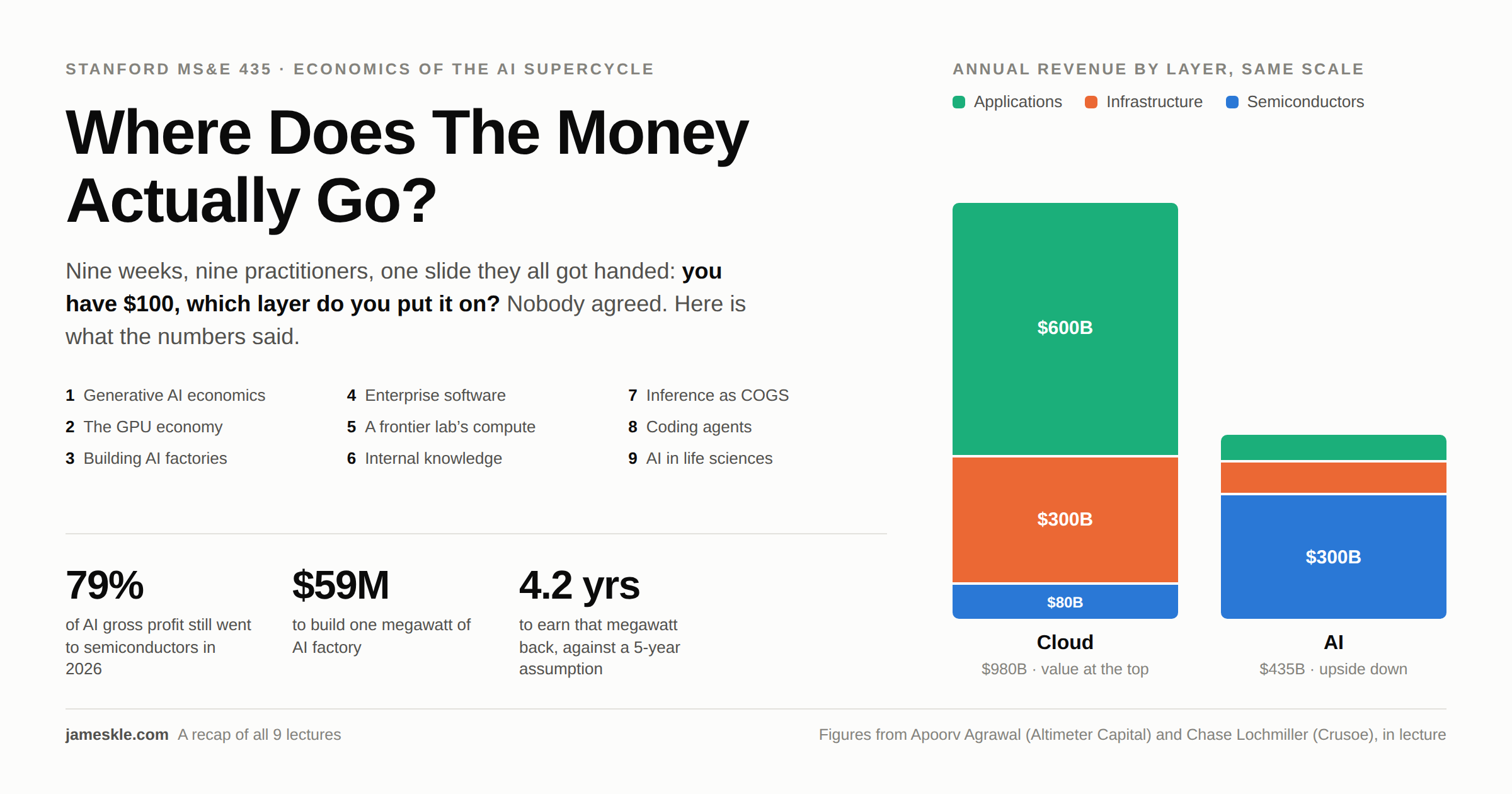
Jensen Huang's five-layer cake goes up twice in Stanford's MS&E 435, and both times the guest gets the same question: you have $100, which layer do you put it on? I worked through all 9 in August 2026. The shape underneath them: semiconductors took 79% of AI gross profit in 2026 and applications took 7%, the inverse of cloud software. This recap walks the course in order, from $59M per megawatt to a 16% antibody hit rate, and argues that "compute is scarce" has become the industry's substitute for a depreciation estimate. Nine lectures, and the number that decides whether any of it pays never appears on a slide.
Stanford CME 296, Condensed: How A Teddy Bear Becomes An Image
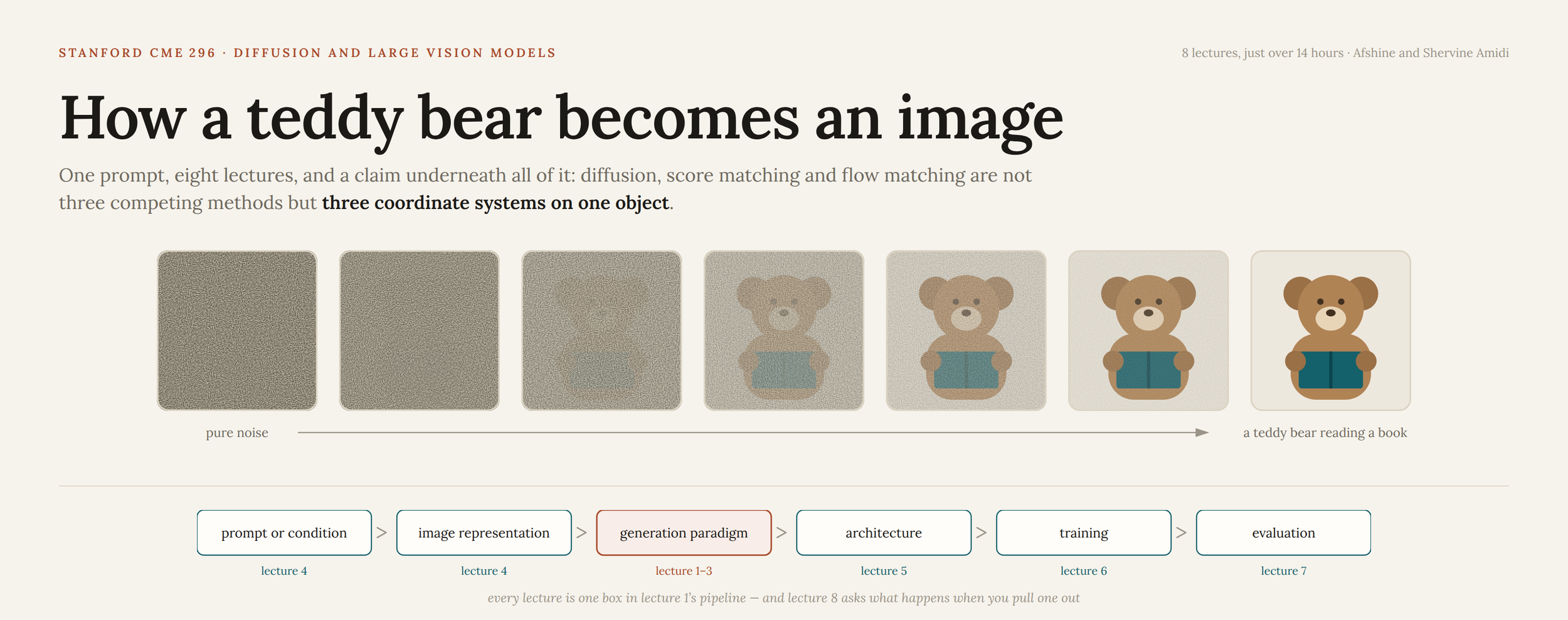
Every lecture in Stanford's CME 296 generates the same picture: a teddy bear reading a book. Noise on the first slide, a finished image on the last. I watched all 8 lectures from Afshine and Shervine Amidi, just over 14 hours of video. The claim underneath them: diffusion, score matching, and flow matching are three coordinate systems on one object. This recap walks the course in order and argues that FID is a regression test the field keeps publishing as a result. One problem won't yield to a better loss, provenance you can strip with a screenshot.
9 Lectures on Self-Improving AI Agents: What I Took Away From Stanford's CS 329A
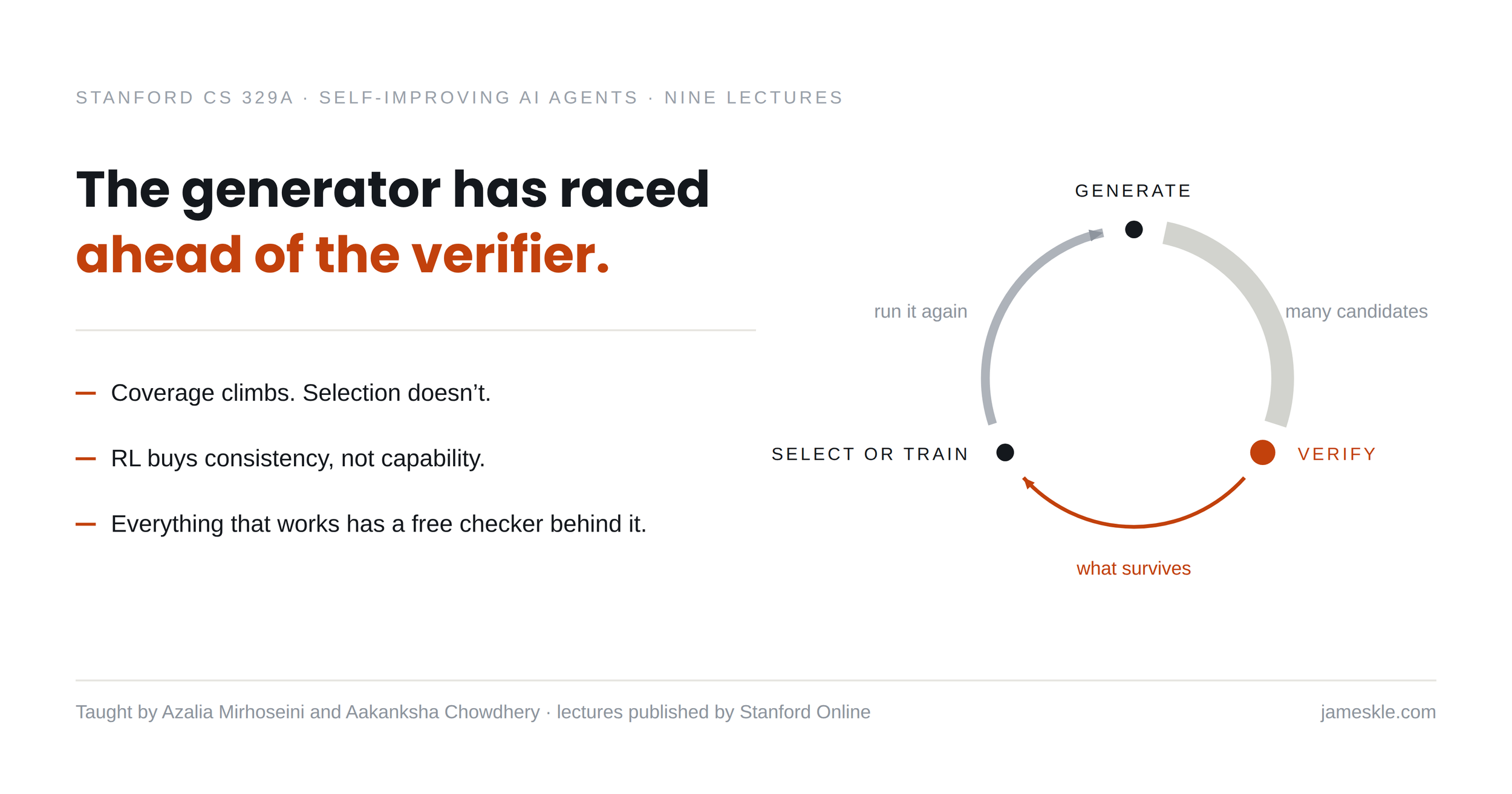
Stanford published 9 lectures from CS 329A, its graduate course on self-improving AI agents, and I spent 3 weeks last month working through them. One argument runs underneath all 9: the generator has raced ahead of the verifier. More samples put a correct answer somewhere in the pile. Nothing tells you which one it is. This recap walks the lectures in the order they were taught, and nearly every number in it came out of a PDF rather than off a slide.
Datacast Episode 128: Building Trust with Founders, VC Funding for the Cloud, and The Next Platform for Data Apps with Jason Risch
Jason Risch is an investor on the enterprise team at Greylock - investing in security, AI/ML, data, infrastructure, and developer tools. Before joining Greylock, he incubated ML companies at AI Fund and was a management consultant at McKinsey. Jason is a Bay Area native, graduated from Stanford, and when not working, can be found reading, hiking, playing Age of Empires, and cheering on Stanford Football.
Datacast Episode 120: Next-Generation Experimentation, Statistics Engineering, and The Modern Growth Stack with Chetan Sharma
Chetan Sharma is the Founder & CEO of Eppo, a next-gen A/B experimentation platform that is designed to spur entrepreneurial culture.
As the 4th data scientist at Airbnb and an early data scientist at companies like Webflow, Chetan has been focused on the maturity curve of growth-stage companies and how to establish data as a central stakeholder in decision-making. He previously led the team that developed Airbnb's knowledge repo and has led data teams focused on production machine learning and instrumentation integrity.
Datacast Episode 117: Vector Databases, The Embeddings Revolution, and Working in China with Frank Liu
Frank Liu is the Director of Operations at Zilliz with nearly a decade of industry experience in machine learning and hardware engineering. Prior to joining Zilliz, Frank co-founded an IoT startup based in Shanghai and worked as an ML Software Engineer at Yahoo in San Francisco. He presents at major industry events such as Open Source Summit and writes tech content for leading publications such as Towards Data Science and DZone. Frank holds MS and BS degrees in Electrical Engineering from Stanford University.
Datacast Episode 115: Product-Led Sales, Community-Led Category Creation, and Unlocking Revenue Data with Alexa Grabell
Alexa Grabell is the co-founder and CEO of Pocus, a Revenue Data platform that is purpose-built for GTM teams to analyze, visualize, and action data about their prospects and customers without needing engineers.
Alexa’s passion for Product-Led Sales started when she led sales strategy & operations at Dataminr, where she built internal solutions to equip sales teams with data. She studied engineering at Vanderbilt University and received her MBA from Stanford University.
Datacast Episode 109: Developer Productivity, Real-Time Data Infrastructure, and The Fat-Tailed Nature of Enterprise Software with Nnamdi Iregbulem
Nnamdi Iregbulem, a Partner at Lightspeed Venture Partners, is a self-taught programmer and lifelong technology nerd. His mission is to increase total software output by supporting entrepreneurs building technical tools for technical people. He focuses on investments in technical enterprise software such as developer tools, application infrastructure, and machine learning.